Beyond the Resume Match: What Actually Makes a Mentor Relationship Work
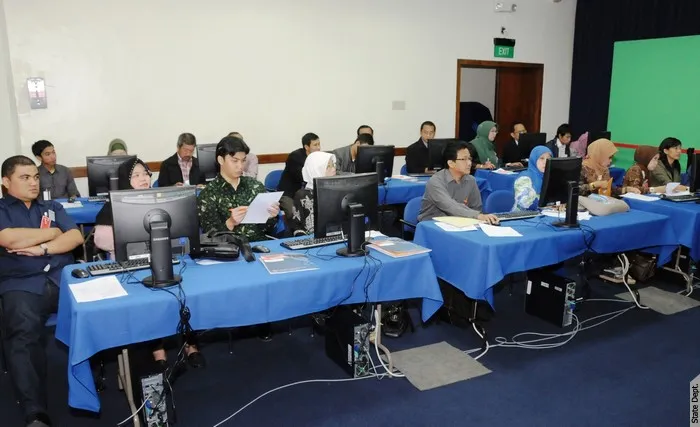
Photo: U.S. Embassy, Jakarta from Jakarta, Indonesia, Public domain, via Wikimedia Commons
When a major financial services firm in Chicago launched its internal mentorship program several years ago, the matching algorithm was elegant in its logic. Senior vice presidents were paired with junior analysts from the same division. Credentials aligned. Industry experience mirrored. The program looked, on paper, like a model worth replicating.
Within eighteen months, participation had dropped by nearly forty percent.
The mentors and mentees were not failing each other because they lacked shared knowledge. They were failing because they lacked shared chemistry — the harder-to-quantify ingredient that determines whether two professionals will be honest with each other, challenge each other, and ultimately trust each other enough to do the difficult work of growth.
This is the mentor mismatch problem, and it is more widespread than most organizations care to admit.
Why Credential-Based Matching Falls Short
The instinct to pair people by title, function, or industry experience is understandable. It is efficient. It is defensible to leadership. It provides a clear rationale that both parties can explain to colleagues without awkwardness.
But career development is not a credential exchange. It is a relationship — one that requires vulnerability, candor, and a degree of psychological safety that cannot be mandated by an org chart.
Research in organizational psychology consistently suggests that the quality of the interpersonal connection between a mentor and mentee is a stronger predictor of outcomes than the mentor's seniority or domain expertise. A mentor who has navigated a completely different industry but who communicates with directness, listens without judgment, and holds the mentee accountable may deliver far more value than a perfectly title-matched senior colleague who operates in the same functional lane but speaks primarily in generalities.
The WisdomApp community has observed this dynamic repeatedly. Learners who connect with mentors based on shared communication styles, complementary values, or even aligned personal philosophies — rather than mirrored career paths — frequently report deeper engagement, more honest conversations, and measurable progress toward their goals.
The Hidden Predictors of Relationship Success
So if credentials are an incomplete signal, what should professionals actually be evaluating when they consider a potential mentor?
Intellectual generosity. Does this person share what they know freely, or do they dole out information strategically? The best mentors are not gatekeepers. They are translators — people who take what they have learned and make it accessible without requiring the mentee to earn each insight.
Comfort with uncertainty. A mentor who presents their career path as a series of confident, deliberate decisions is either misremembering or performing. The mentors who create the most growth are those who can say, honestly, "I did not know what I was doing at that stage either — here is what I tried and why it did or did not work." That kind of transparency is only possible when a mentor is comfortable acknowledging the ambiguity that defined their own journey.
Calibrated challenge. There is a meaningful difference between a mentor who validates and a mentor who stretches. Neither pure cheerleading nor relentless critique produces growth. The most effective mentors have an instinct for when to affirm and when to push — and they develop that instinct by paying close attention to the individual in front of them, not to a generic notion of what a mentee at a given career stage should need.
Communication rhythm compatibility. This is rarely discussed, but it matters enormously. A mentee who processes ideas through long, exploratory conversations may struggle with a mentor who communicates in terse, action-oriented directives — and vice versa. Neither style is superior, but a mismatch in communication rhythm can make even substantive guidance feel inaccessible.
When Mismatched Pairs Produce Breakthroughs
Some of the most productive mentorship relationships on record look, from the outside, like they should not work at all.
Consider the marketing director who sought guidance from a retired military officer with no background in consumer brands. The surface-level match was nonexistent. What the mentee found, however, was a mentor whose experience in high-stakes decision-making under pressure, whose discipline around prioritization, and whose blunt feedback style cut through the noise in ways that industry-adjacent mentors never had. The relationship produced a career inflection point that the mentee later described as the most formative professional experience of her life.
Or consider the early-career software engineer who connected with a mentor who had spent three decades in nonprofit leadership. The technical overlap was zero. But the mentor's deep experience navigating organizational politics, building coalitions across departments, and communicating complex ideas to non-technical stakeholders gave the engineer a set of tools that no coding-adjacent mentor could have provided at that particular moment.
These are not anomalies. They are illustrations of a principle that WisdomApp's platform is built around: wisdom is transferable across contexts, and the most valuable guidance often arrives from directions you did not anticipate.
A Framework for Evaluating Fit
Before committing to a mentorship relationship — or before deciding to discontinue one that is not producing results — consider the following questions honestly.
After your first substantive conversation, did you feel challenged or merely comfortable? Comfort is pleasant, but challenge is productive. If a potential mentor primarily reinforced what you already believe, that may signal an absence of the friction that generates real growth.
Did the mentor ask more questions than they answered? Great mentors are diagnosticians before they are prescribers. A mentor who listens carefully before offering guidance is demonstrating the intellectual humility that makes their eventual guidance worth receiving.
Were you willing to share something professionally uncomfortable? The quality of a mentorship relationship can often be gauged by how quickly both parties move past surface-level conversation. If you found yourself editing your honesty in the first meeting, pay attention to why.
Does this person's definition of success align with yours — or helpfully challenge it? A mentor whose vision of a successful career is fundamentally at odds with your own values is not necessarily a poor match. But you should enter the relationship with eyes open about where your frameworks diverge.
Redefining the Match
Organizations that invest in mentorship programs — and individuals who invest their time in seeking mentors — deserve more than a credential-matching exercise. The real work of mentorship is relational, and the criteria for a good match should reflect that reality.
At WisdomApp, the premise is straightforward: the right mentor is not always the one who has done exactly what you are trying to do. Sometimes, the right mentor is simply the one who sees you clearly, speaks to you honestly, and has the wisdom to know the difference between the guidance you are asking for and the guidance you actually need.
Credentials open doors. Chemistry determines what happens once you walk through them.